Wednesday, April 13, 2011

Gibraltar Straight

It’s always a milestone in any journey: crossing Gibraltar Straight. We look forward to it for weeks and then it’s over in an hour or two. But thank God we’re off the Atlantic. From a sailor’s point of view, the Mediterranean really is a big lake; there are hardly any tides and hardly any swell. Sailing the Mediterranean is a walk in the park, so to speak.


The weather is always a surprise in Gibraltar Straight (as it is anywhere else, I suppose). Sometimes gales get bottlenecked to full fledged storms and passing the straight is like passing a cactus. Sometimes it’s spectacularly clear and you can count the leaves on the trees on either side. Once I’ve seen a wind-still day produce strange whipped-cream globs of clouds just sitting on the water, for us to circumvent.


Today conditions are boring but not very trying. Rain and fog keeps the Rock of Gibraltar from our sight. We pass along the African Coast, along with countless other ships, safely separated in a convoy going west and one going east. And as we stand and stare and each other, we notice the dorsal fins and arched backs of a large herd of dolphins moving gracefully between us out the Mediterranean and onto the Atlantic.

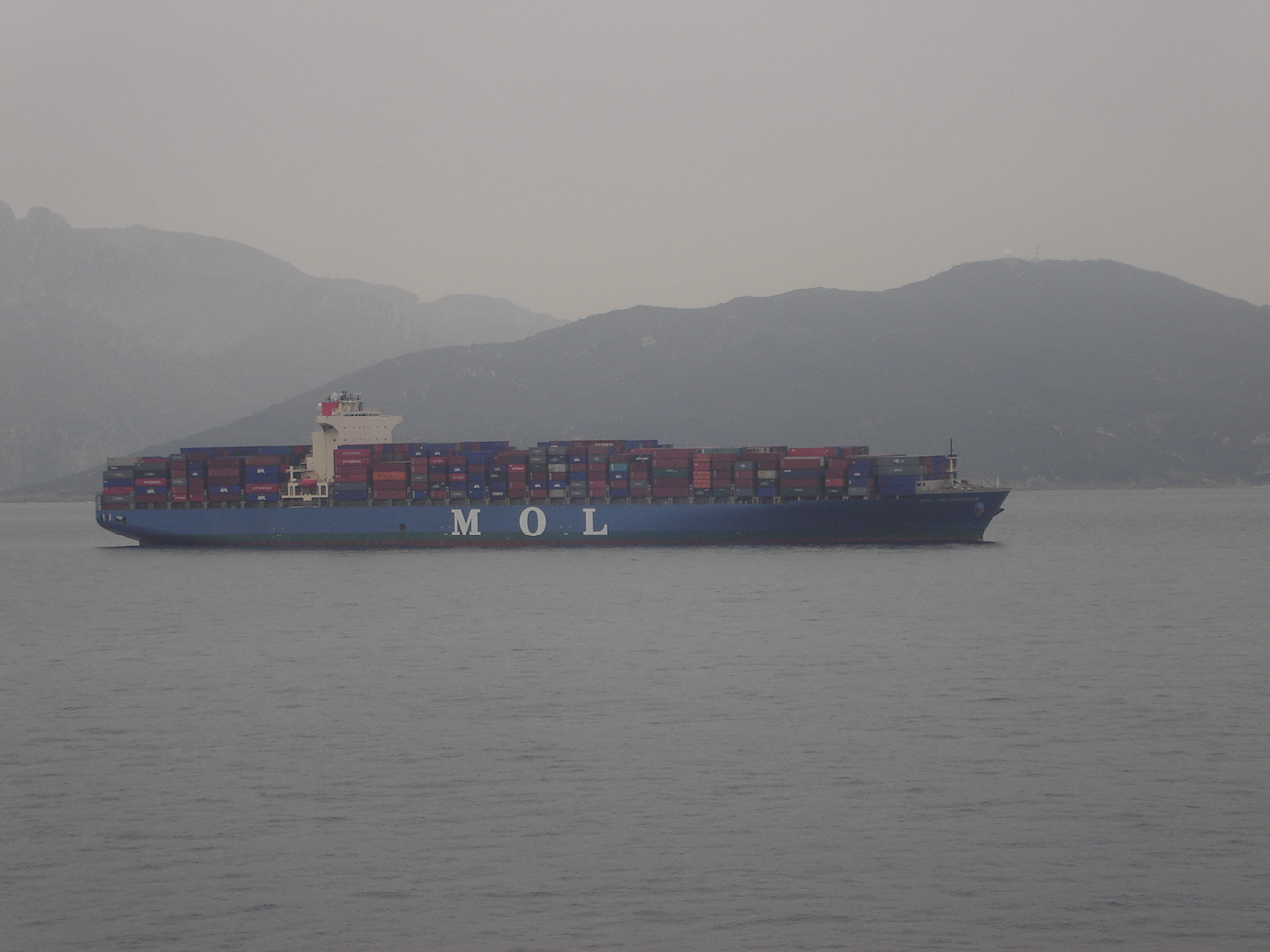
A container ship in the Gibraltar Straight
Dolphins in the Gibraltar Straight

Monday, April 11, 2011

Casablanca, Morocco

A couple of tired-eying line guys tie us up in the congested cargo port of Casablanca.
“Where’s Rick’s?” we yell, visibly making the line guys even more tired. We’re not the first foreign fools to refer to the 1942 movie, and we’re also not the first to forget that Casablanca existed long before Humphrey Bogart, and has existed long since.


In 2004 a brave woman from Oregon named Kathy Kriger moved to Casablanca and opened the only Rick’s Café in town. I’m sure it attracts many a foolish foreigner who come from afar to sing along with Sam. Well, if Kathy can stand it, so can they, or something like that.


We’re only here for a day; we’ll leave in the late afternoon. The town curves around the port like a cupped hand. An impressive mosque stands on the edge and I’d love to go see it. Unfortunately there’s no time. I’d also love to go see the 1930 Sacre Coeur Cathedral or the more recently built Notre Dame de Lourdes; two massive churches smack in the middle of Islamic Morocco.


Maybe some other time. Maybe not…
An impressive mosque close to the port of Casablanca, Morocco

Casablanca, Morocco
Casablanca, Morocco
 

Sunday, April 10, 2011

Agadir, Morocco

We’re in Agadir, Morocco, for only half a day. Ahead lies the town in the blistering heat; a scorching dessert wind comes pelting over the mountains, carrying sand that scrapes the paint off the bulkheads and settles in corners and blows in through every gap or inlet.


To our port side, the pretty blue ship Taurus J is loading containers. Behind us lies a ship from Lima with a curious green hull. Half way the morning the cute little cruise ship we saw yesterday in Arrecife comes floating in. I recognize it now: it’s the Corinthian II. She was also with us in Senegal.


As we get ready to depart, the wind increases to a whopping gale force 8 and all brace for a rough ride to Casablanca. I can’t wait to see the lush green shores of Northern Europe, but first we need to cut through Gibraltar Strait and spend a month in the Mediterranean. After that we go back across the Atlantic. Northern Europe we won’t see for a while.


Agadir, Morocco
Agadir, Morocco

The mini cruise ship Corinthian II; our companion for the last few days
Cargo ship Taurus J  loading containers in Agadir, Morocco
 
Another cargo ship in the port of Agadir, Morocco


Saturday, April 9, 2011

Arrecife, Lanzarote - Canary Islands

It’s hard to top an evening like last night’s, or to come down to earth after it for that matter. The Freon leak was quickly found and soldered shut again, long before any provisions would have started to melt. The storekeeper was assuaged and Ludin was instructed to stay away from the galley for a while, which would be best for everyone.


Arrecife, the capital of Lanzarote, the northernmost Canary Island, promises quiet delight and restful resorts, and even boasts a tourism industry based on tranquility. To us, Arrecife is a hardy sprinkle of white condos far out in the distance but still it manages to look fantastically boring. The hills that surround it are barren, and so are the plains and pretty much the whole island. Not a single tree catches the eye.


Still, it must have some allure. There’s a monstrously large cruise ship tied up behind us, and up front is a cute little cruise ship. At some point during the day, a third huge cruise ship docks. There’s no telling what might be out there but thousands were here to see it.


Cruise ship Fantasia in Arrecife
A cute little cruise ship off our bow
The white town of Arrecife


A third cruise ship docks, one owned by Island Cruises

Thursday, April 7, 2011

Iglesia de la Concepcion in Santa Cruz, Tenerife - Canary Islands

By the dry bed of the Barranco de los Santos and crouched amidst high rises and private homes stacked like domino stones, lays the pretty, horizontal cathedral Iglesia de la Concepcion; its slender and square belfry like a bastion overlooking the sea.


The indented chapels could use a lick of paint on the outside but on the inside the church is well kept, spacey and utterly hospitable. When Draga and I enter we find the congregation conducting a worship service. We scoot through the isles and sit down somewhere and listen to a friendly Father deliver his sermon. I have no idea what he’s saying but around me the world stands still and becomes reverent, and I look at the statues, the paintings and the impressive arches that hold up the ceiling.


I’m holding Draga’s hand. I want her to know that I understand that she belongs to a world that’s not made from steel and peeling paint, and that needs to be perpetually maintained at the price of human lives. She belongs to an eternity that, although it must be misunderstood by the merits of its nature, can be wholly enjoyed in silence and surrender.


After the service the congregation shuffles out and lingers by the entrance, chatting and laughing. I remain inside and take pictures of the statues (with flash because the lights go out as soon as the door opens). When we finally also exit, we walk quietly around the church. Near the belfry we find a plaque that says rather esoterically:


“Although it was built very slowly (XVIth - XVIIIth century) the temple presents a great unity of style. The first edifice, that today corresponds to the first part of the central nave, was a little, rectangular ground-plan church. Along the XVIIth and XVIIIth centuries other naves were added to it, changing the temple to the present church of five naves, transept with cupola and isle chapels. 


The tile roofs with two and four slopes corresponds in the inside with the traditional Mudejar coffered ceilings. The walls are made with rubblework being the hewn stone only used in the corners of the edifice, in the tower and on the main facade on which a dark basalt is used. Outside the Canarian wooden balconies stand out, being considered a unique example of the architecture of the islands.”


Whatever cultural significance this church may have for the Canarians, to us it was a brief symbol of safety, of being part of something that must evolve like all other things, but which was based on something eternal that will never go away. Draga and I are part of each other. Today we were part of the congregation of the Church of the Conception in Santa Cruz, Tenerife. We are part of the much larger Body of Christ, equally unfathomable and ultimate more mysterious and eternal. Standing hand in hand in front of this cathedral, to which we will probably never return, we realized that we were part of the great union of heaven and earth; a marriage that can never be described in any human language of logical system, but which defines us at large and at every tiny detail; from the purpose of our lives up to the level of everyday’s most quiet need.


Iglesia de la Concepcion in Santa Cruz, Tenerife – Canary Islands


Could use a lick of paint
Staring over the heads of the congregation to the impressive Marian altar piece

Detail of the Marian altar piece of Iglesia de la Concepcion in Santa Cruz, Tenerife
Arches hold up the ceiling - Iglesia de la Concepcion in Santa Cruz, Tenerife
Mary and Jesus, probably
The baptism of Jesus; stained glass window of Iglesia de la Concepcion in Santa Cruz, Tenerife
Veronica - Iglesia de la Concepcion in Santa Cruz, Tenerife
After the service the congregation lingers
Iglesia de la Concepcion in Santa Cruz, Tenerife - Canary Islands

The Christless cross, unusual for Catholic churches but not in Santa Cruz,
which city symbol is the Christless cross.
(To the right, that's Draga, by the way... )

Wednesday, April 6, 2011

Santa Cruz, Tenerife - Shore leave per Captain's orders

He called me into his office, the captain, which usually means you’re fired. He wasn’t going to fire me, he said immediately when I entered, trying to remember my latest and gravest infractions. But he wanted to know why my work-and-rest hours list looked like a Dalmatian. It’s because stuff falls apart, I explained. Well, he assured rather loudly, stuff won’t be falling apart tonight because you and that Draga of yours are going out!


Rounding up that Draga of mine and convincing her that we had to go ashore per Captain’s orders took a while, but at 1900 sharp we marched off, tasting free air for the first time in weeks.


Of course we veered towards the old church called Iglesia de la Concepcion, where we joined a worship service. Then we crossed a noisy shopping street where Draga bought me 18 pair of Nike socks, vowing she would throw my old ones out (But they’re only three years old, I tried. I bought them in Ketchikan! They’re souvenirs!). We turned corners and crossed squares and finally we ended up in the gentle care of senior Julian at his fine eatery called Dorada, had ham and cheese and pizza and grilled fish, and babbled nose to nose about living in a little house somewhere, with a dog and a cat and plants on the window sills. No pagers, no machines that fall apart in the middle of the night.


Rosy and content we headed back to the ship and what I had tried not to dread the whole evening became reality in the cheerful face of Ludin, smiling at me from the top of the gangway.
“Boss!”
“Ludin…?”
“No more Freon inside fridges. Storekeeper very angry.”
“What have you done so far?”
“I put more Freon.”
“How much…?”
“Only one bottle.”
“You put fifty-seven kilo of R22 in a seventeen-kilo system?”
“Yes, chiep. Shall I put more?”
“No Ludin, let’s continue tomorrow morning,” I say stepping by him as I follow my Draga down the corridor, to our little house with a dog and a cat and flowering plants on all the window sills.

A pleasant pedestrian street in Santa Cruz, Tenerife
Same street, but now viewing in the direction of the Church of the Conception.
From where we sat at Julian’s restaurant Dorada
Julian, a bueno hombre who works at Dorada restaurant
Four cruise ships in a row in the port of Santa Cruz, Tenerife
Quaint enclaves of houses built on the hill slants, Santa Cruz, Tenerife

Monday, April 4, 2011

Dakar, Senegal - a huge city in the middle of nowhere

As we pull into the sandy haze, and the city of Dakar, Senegal emerges, the first thought that crosses my mind is: My goodness, who on earth put this here?


We’re in the Sahara, geographically spoken, but Dakar is a handsome metropolis with high rises galore and the obvious regalia of bustling international trading grounds. We’re not the only ones here; the anchorage is crammed with ships waiting to be hailed in. We see lot after lot of brand new cars, containers, steel in massive rolls. There’s even a cruise ship tied up: the Corinthian II.


Directly off the coast lies a pretty island. The buildings are old and majestic. Only later we learn that this is a place of atrocity and horror. Ile de Goree was once a holding house for slaves. While the owner and his family dined upstairs, up to 200 people were kept in tiny cells down below. Guards could have an unchecked go at whatever poor sap was taken there, along with his wife and children. It’s a museum now. Fortunately for all of us, there’s no time to go ashore. Ludin’s tender sensibilities won’t take another blow, I'm sure.

Dakar, Senegal in the sandy haze
Sunrise over a ship at the anchorage of Dakar, Senegal
Ile de Goree, off the coast of Dakar, Senegal
Dakar, Senegal
Dakar, Senegal
Dakar, Senegal
The Corinthian II docked in Dakar, Senegal

Sunday, April 3, 2011

Banjul, The Gambia

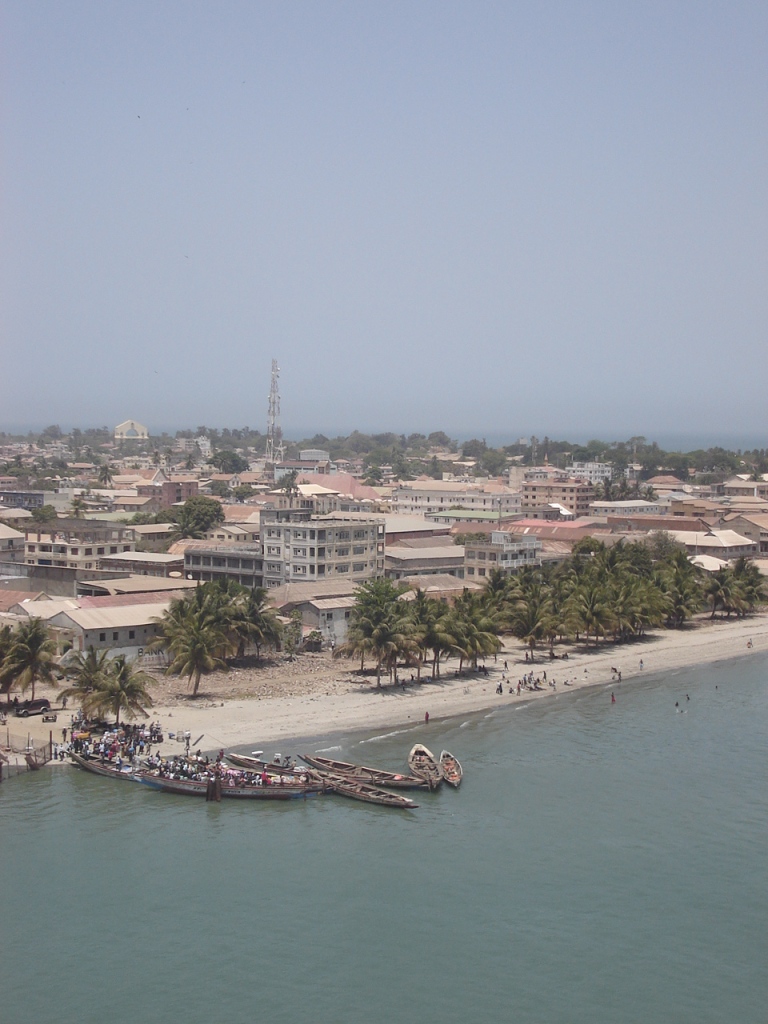
We arrive early but when the sun comes up we see a strangely attractive town. It’s not very large because it’s on a relatively small island in the river Gambia. The country is called The Gambia and it’s about a quart of the size of The Netherlands, which makes it a very small country indeed.


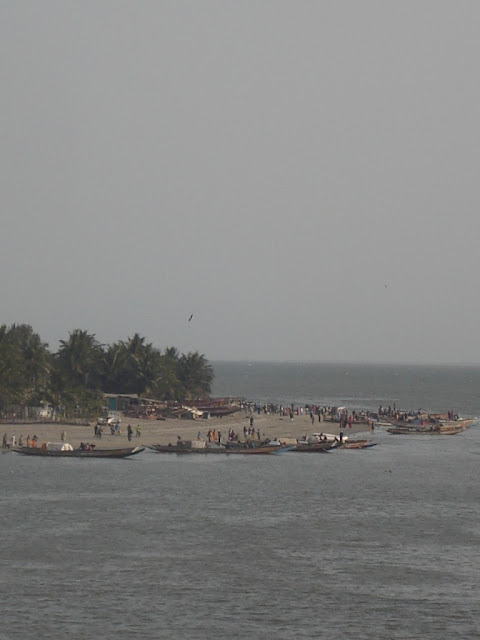
Banjul awakes under a golden sandy haze. From afar come flat and sleek fisher boats. They beach where people are waiting to buy the catch. Below, the dock fills up with merchants and dancers and everybody is donned in magnificent and brightly colored garb. They’re tall and slender and move slow. A beautiful people.


Beautiful enough to entice Ludin for a walk. Something urged him to leave his monstrous Canon on the ship, but he left, dressed in his finest shirt and nose in the air. Two hours later he was back. He had no shirt on. Wide-eyed he paced up the gangway.
“No good,” he brought out, “They poor, chiep. They very bad poor.”
“What happened to your shirt?”
“I gave to that poor bastard.”
“Which poor bastard?”


It took Ludin a while to find his bearings, but over a cup of coffee in the messroom he told his story. Apparently, when Ludin was about to walk out the gate into the city he was stopped by two burly guards. They told him that the city was very dangerous and that he could only go out if they would accompany him. Initially Ludin was quite pleased to have an armed escort. The three marched on in the best of spirits but the spirits turned when Ludin found a city of misery, hopelessness and neglect.
“Only girl, chiep,” he sobbed, “Already have baby. And flies everywhere, and no eat.”


After that Ludin’s story lost cohesion. But from the fragments we deducted that Ludin’s guards, now suddenly armed with machetes, explained to him that they only guarded people on even days. On odd days they robbed them. What day is it now, they asked Ludin.
“It’s my birthday,” said Ludin.
“That odd,” said the guard.


Ludin then began to freely donate his money to the locals and even gave his shirt to one of the guards. The guards, not at all unwilling fellows, escorted Ludin safely back to the port gate.


“Give me your shirt,” we heard Ludin say to the storekeeper as we began to exit the messroom.
“I no have extra shirt, you bum!” the storekeeper replied, and life returned to normal. Later in the afternoon, the lines came in and we set off north. I may be mistaken, but I think I saw a beautiful, tall and slender man wearing Ludin’s shirt and waving a machete.


Dancers in Banjul, The Gambia
Fish market in Banjul, The Gambia
Dock merchant in Banjul, The Gambia
Beautiful ladies in Banjul, The Gambia
Banjul, The Gambia

Friday, April 1, 2011

Mindelo, Sao Vicente, Cabo Verde

Cabo Verde is a island group consisting of nine larger and a hardy sprinkling of smaller islands. And it’s one of the few places that hasn’t lost its indigenous population to invasion of the present. Locals will proudly inform the traveler that when the Portuguese explorer Luigi da Cadamosto first arrived here in 1455, there was nobody living here. The traveler may rest his gaze upon this lush land, daubed in festive shades of brown and grey, and wonder why…


We have arrived at Port Grande, the naturally shielded harbor of Mindelo, the main town on the island called Sao Vicente, which is the second most important island of the group. Across the water lies the island Sao Antonio, which was settled by mostly Jewish folk in 1548. They existed there for two centuries pretty much undisturbed because the island was not situated near any main shipping routes.


I’m overlooking these barren turds, wondering why anybody would want to live here. But they did. I’m sure the Jews who came here were on the run from persecution and found their little haven a gift from God. I have no time now but I would love to come back here some day and check out Sao Antonio.  Are they still there? Did they go to Israel? Did their religion evolve in any significant way?


Some day I will return.


Mindelo, Sao Vicente, Cabo Verde


Related Posts Plugin for WordPress, Blogger...