Sunday, April 3, 2011

Banjul, The Gambia

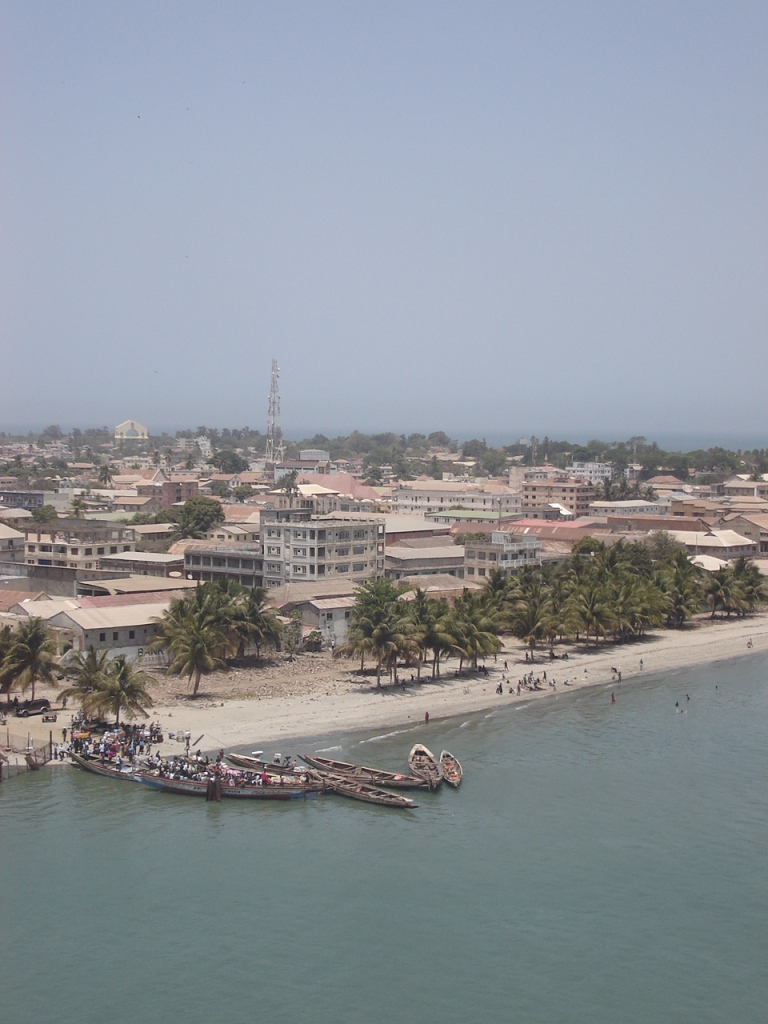
We arrive early but when the sun comes up we see a strangely attractive town. It’s not very large because it’s on a relatively small island in the river Gambia. The country is called The Gambia and it’s about a quart of the size of The Netherlands, which makes it a very small country indeed.


Banjul awakes under a golden sandy haze. From afar come flat and sleek fisher boats. They beach where people are waiting to buy the catch. Below, the dock fills up with merchants and dancers and everybody is donned in magnificent and brightly colored garb. They’re tall and slender and move slow. A beautiful people.


Beautiful enough to entice Ludin for a walk. Something urged him to leave his monstrous Canon on the ship, but he left, dressed in his finest shirt and nose in the air. Two hours later he was back. He had no shirt on. Wide-eyed he paced up the gangway.
“No good,” he brought out, “They poor, chiep. They very bad poor.”
“What happened to your shirt?”
“I gave to that poor bastard.”
“Which poor bastard?”


It took Ludin a while to find his bearings, but over a cup of coffee in the messroom he told his story. Apparently, when Ludin was about to walk out the gate into the city he was stopped by two burly guards. They told him that the city was very dangerous and that he could only go out if they would accompany him. Initially Ludin was quite pleased to have an armed escort. The three marched on in the best of spirits but the spirits turned when Ludin found a city of misery, hopelessness and neglect.
“Only girl, chiep,” he sobbed, “Already have baby. And flies everywhere, and no eat.”


After that Ludin’s story lost cohesion. But from the fragments we deducted that Ludin’s guards, now suddenly armed with machetes, explained to him that they only guarded people on even days. On odd days they robbed them. What day is it now, they asked Ludin.
“It’s my birthday,” said Ludin.
“That odd,” said the guard.


Ludin then began to freely donate his money to the locals and even gave his shirt to one of the guards. The guards, not at all unwilling fellows, escorted Ludin safely back to the port gate.


“Give me your shirt,” we heard Ludin say to the storekeeper as we began to exit the messroom.
“I no have extra shirt, you bum!” the storekeeper replied, and life returned to normal. Later in the afternoon, the lines came in and we set off north. I may be mistaken, but I think I saw a beautiful, tall and slender man wearing Ludin’s shirt and waving a machete.


Dancers in Banjul, The Gambia
Fish market in Banjul, The Gambia
Dock merchant in Banjul, The Gambia
Beautiful ladies in Banjul, The Gambia
Banjul, The Gambia

Friday, April 1, 2011

Mindelo, Sao Vicente, Cabo Verde

Cabo Verde is a island group consisting of nine larger and a hardy sprinkling of smaller islands. And it’s one of the few places that hasn’t lost its indigenous population to invasion of the present. Locals will proudly inform the traveler that when the Portuguese explorer Luigi da Cadamosto first arrived here in 1455, there was nobody living here. The traveler may rest his gaze upon this lush land, daubed in festive shades of brown and grey, and wonder why…


We have arrived at Port Grande, the naturally shielded harbor of Mindelo, the main town on the island called Sao Vicente, which is the second most important island of the group. Across the water lies the island Sao Antonio, which was settled by mostly Jewish folk in 1548. They existed there for two centuries pretty much undisturbed because the island was not situated near any main shipping routes.


I’m overlooking these barren turds, wondering why anybody would want to live here. But they did. I’m sure the Jews who came here were on the run from persecution and found their little haven a gift from God. I have no time now but I would love to come back here some day and check out Sao Antonio.  Are they still there? Did they go to Israel? Did their religion evolve in any significant way?


Some day I will return.


Mindelo, Sao Vicente, Cabo Verde


Wednesday, March 30, 2011

Crossing the Atlantic

Crossing the Atlantic Ocean
Lulled by the gentle, Atlantic swell we glide eastward. It’ll take us four days to get where we’re going. After more than seventy days of port hopping we’re all kind of glad to be out on the open again. Four days isn’t much, but it’s four days without maneuvering and for and aft and bolting down the doors in dubious ports. The engines rumble along and all doors are wide open. Padlocks sway idly on hooks. Here and there are clothe lines with laundry and tool bags safely left in corners during coffee breaks. For four days we’re an island.


I remember crossing the Atlantic for the first time, in the late eighties. I worked on a reefer ship that ran bananas from central America to Europe. My first port on the other side was Almirante, Panama, a tiny fart of a town consisting of nothing but dilapidated shacks. We were warned not to go ashore because the Americans were rounding up the general, and had the locals all stirred up. We went anyway, of course. I remember that utterly exhilarating sense of being in another world. I was not only in another country with another climate and on another continent, I was in a kind of place that didn’t exist in the northwest Europe where I came from.  People cooked their meals on fires outside their huts. They congregated and made music during work breaks. There was very little electricity and there can’t have been much television. As far as I can tell, the people of Almirante were blissfully unaware that the Americans were thought to have them all stirred up.


A lot has happened since then; I’m afraid I lost count a bit. The wall came down soon after Almirante and eastern and central Europe broke open. That same decade Yugoslavia spiraled into a civil war and Belgrade got shot to shit by the NATO. Kuwait was liberated and a decade later Irak was democratized. Afghanistan was in there too somewhere. In the mean time, six weeks old newspapers became condensed versions emailed to the ship by the home front first, later by the World radio.


Now we’re headed east. We going to Africa; west coast first and then into the Mediterranean to the north African shores. During coffee breaks we watch CNN because these days we have satellite receivers on board. We have telephone and internet, just like everybody else. That is to say: perhaps not in Libya. Who knows what goes on over there? All we know is that they’re getting the shit bombed out of them. CNN makes us believe that they have what was coming. Just like all the others. Evildoers! Mad dogs of the middle east!


Perhaps somewhere in Libya people still cook their food on fires in front of their houses. Maybe there are even still a few who gather to make music during work breaks. If that is so, then they probably also let their clothes out to dry on lines, or tool bags in corners when they go off on breaks, without having to fear that someone will come to swipe them.


I hope so.

Monday, March 28, 2011

Barbados - The final gathering before crossing over

Morose from looping around South America we pull into Bridgetown, the capital of the island Barbados. And we’re not alone. There are four huge cruise ships in today and they spew their passengers out over the town. Three centuries of British rule, says a line guy, but now we’re discovering our African roots.


This afternoon we’ll cast the lines off a South American shore for the last time and head just there: Africa. We’ll be crossing the Atlantic for four days.


Into the sun we’ll go.
A cruise ship in the port of Bridgetown - Barbados
Cruise ships approaching the port of Bridgetown - Barbados
Bridgetown, Barbados
Two more cruise ships in the port of Bridgetown - Barbados
Morose from looping around South America we pull into Bridgetown, the capital of the island Barbados. And we’re not alone. There are four huge cruise ships in today and they spew their passengers out over the town. Three centuries of British rule, says a line guy, but now we’re discovering our African roots.


This afternoon we’ll cast the lines off a South American shore for the last time and head just there: Africa. We’ll be crossing the Atlantic for four days.


Into the sun we’ll go.

Sunday, March 27, 2011

Fort de France - Martinique

Martinique has a few claims to fame. It’s somehow believed that the first “Western” coffee plant was imported to Martinique from Ethiopia. This was in 1720 and it must have caused the Martiniquans to stay up later than usual and embrace whatever entertainment they could device. Not long after, a baby girl was born in the island town of La Pagarie, and named Marie Josephe Rose Tascher de la Pagarie. Somehow she managed to catch the eye of no one less than Napoleon, and she became Empress Josephine Bonaparte.


All that excitement enticed Draga to head for shore, and she left around noon. Remnants of fort St Louis and a beautiful old church just a few steps away from the ship lured, but Draga’s idea of an afternoon out is to sit somewhere, drink coffee and look at people going places. An hour later she was back, soaking wet, mumbling that Fort de France is a joke; only shops and no coffee places.


As she paced nose-up top the mess room to finally get her coffee I couldn’t help wondering what that cathedral looked like on the inside, or fort St Louis, or whatever happened to that first Western coffee plant that they imported to Martinique from Ethiopia.
Fort St. Louis - Fort de France , Martinique
Fort de France , Martinique

Saturday, March 26, 2011

Bateau des Iles - A House made from a Ship at Bourg des Saintes, Iles des Saintes

Coming into the marina of Bourg des Saintes, on Terre de Haut, the largest island of the Iles des Saintes archipelago, the observant visitor will notice a big white bow sticking out of a rock on the water. On its flank is written Bateau des Iles. Only then will the visitor notice that it’s not a ship but a house, build on the real bow of some old ship.


I remember watching a Discovery Channel special about this house, but I hadn’t remembered where it was. I do remember it cost the owner a fortune to get the bow there, and to convert it into a house. But it was his life’s dream, and his wife (interviewed on the side) seemed happy with it too. I wondered then, and am still, why anyone would want to drag some old bow onto a plot of land and not (a) build a new house in the shape of a ship, or (b) buy a ship and live on it.


If I would feel the need to live on a boat (I’m now living on a boat, but I mean when I’m not working), I’d probably buy some old ship somewhere, buy a waterfront plot and build a dock to park the boat against. Then the dock could be expanded into a house, based on the boat. Now that I’m thinking, I’d probably make the whole thing detachable so that Draga and I could take the living room and kitchen out for a spin on Sunday afternoons, while the garage and the bathroom stay behind.


We could even park a camper in the carport and connect it to the main structure with a flexi-duct, so that when we come back with the living room, we can take the spare bedroom out shopping. And maybe we can build a bedroom out of a helicopter.


There, it’s been decided. I’ll tell her over dinner. Now all we need to find is a waterfront plot, not too expensive and preferably close to home, and a supermarket nearby with a movie theatre, and a library of course. And Draga wants a dog, so there has to be a park in the immediate vicinity.


Real estate agents may use the below comment form. All reasonable quotes will be taken seriously.
Bateau des Iles - A House made from a Ship at Bourg des Saintes, Iles des Saintes

Friday, March 25, 2011

The delightful church of Bourg des Saintes


The Church of Bourg des Saintes
In Bourg des Saintes, Iles des Saintes, just off Rue du Marigot, stands a delightful little church, with a modest steeple that still hovers like a beacon over the town and doors wide open. Inside rules an atmosphere of Caribbean ease. There seems to be an emphasis on the humanity of Christ in this church, and more specifically on the humanity of His earthly parents and the humanity of their little family.

Salt of the earth; light of the world
The main altar of the church of Bourg des Saintes


The face of the main altar is as modest as the rest of the church, and features a crucifixion and the words “Salt of the Earth; Light of the World.” To the right of Jesus on the cross is painted what seems an angel. Elsewhere in the church stands a statue of that same person:

Saint George / Saint Michael in the church of Bourg des Saintes


An image of someone killing a dragon is often depicting either St George or St Michael. George is often shown piercing the dragon with a lance. He also usually carries the Georgian symbol of a red cross on a white field, or at least some obvious combination of these colors. And he’s most often seated on a white horse. Michael doesn’t need a horse because being an archangel, he has wings to get around by. We don’t know how it got the better of the dragon; all we know is that he fought him. There are three Michaelean battles recorded in the Bible; two of which are with satan. Once Michael expels him from heaven (Revelation 12:7-12) and once he argues with him over the body of Moses (Jude:9). But in both accounts he doesn’t kill him or run a lance down the dragon’s throat. The statue of the dragon-slayer in the church of Bourg des Saintes has the lance, colors and theriocidic mission of George, but lacks the horse of George and has the wings of Michael. I’m not sure if this weird hybrid is a cultural phenomenon to be treasured or a complete screw up of some ignorant sculptor, but I’ll keep my eye open for more of these saint Georchels.

Statue of a lovely lady - I wonder who she is...


A lovely eyeing lady holds a crucifix. No idea who she is. She holding on to three red flowers; three white lilies are a symbol of purity and thus Mary, but Mary is mostly dressed in blue and she wouldn’t be holding a crucifix. I sure hope this isn’t supposed to be Mary and the sculptor who created Saint Georchel was running a two-for-the-price-of-one special. This lady is outfitted as a nun but I don’t know which kind. I’m obviously not less ignorant than any sculptor.

Mary teaching Jesus from a scroll


Mother teaching a royally robed pre-adolescent from a scroll. It’s a very small scroll. Maybe a shopping list, but certainly not Isaiah or something like that. It’s highly unlikely that Mary ever came close enough to any kind of scroll that she could touch it, and certainly not to a scroll that Jesus would famously learn from. It looks like our sculptor was running a three-for-one special.

The Good Shepherd


The Good Shepherd, presumably. The sheep also functions as holder for the cable of the sound system.

A delightful statue of Joseph, depicted as carpenter, holding on to the infant Christ.

The church of Bourg des Saintes, viewing down the isle to the entrance.

The steeple of the church of Bourg des Saintes looming over the town.

Thursday, March 24, 2011

Bourg des Saintes, Iles des Saintes

Technically, we’re in France. At least, that what I’m guessing. Nobody really seems to know, or care for that matter, and neither do I. But we’re in French speaking country, and we’re paying in Euro.


We’re docked in an enchanting bay, off the coast of a town called Bourg des Saints, which is on a Caribbean Island called Terre des Haut, which is part of a group of islands called Iles des Saintes, which is part of Guadeloupe, which is a part of France. At least, that’s what I’m guessing and trying to piece together from various flyers. Of course I could consult the Wikipedia, but where’s the fun in that?


Part of our intensely secret mission, which I can’t talk about, is hauling super-secret goods ashore. We have a few little boats for that, and I’m the one who’s supposed to keep those bastards running, and for that I need to do periodic inspections on the fly. That means that I take boat 1 to shore, boat 2 back to the ship, boat 3 back to shore and boat 4 back to the ship. And in between waiting for the next boat (10 minutes) I dart through alleys and dash across squares – in full regalia, sweating oil and shaft grease and with tools and weaponry sticking out of every pocket – shooting pictures left and right.


My flash-impression of the three streets surrounding the marina is a lot more positive than that of St Bart yesterday. Tourism doesn’t seem to have picked up much here; locals saunter about their modest domiciles, a few T-shirt shops hang out their slowly fading wares, and a  hardy helping of little oompah-loompah scooters stands hopeful outside a rental joint.


Folks mostly live off fishing, informs me a kind gentleman from beneath the Good Shepherd. A nameless church on Rue du Marigot lured me in. The gentleman has seen many shapes and forms come in but perhaps not a besmirched engineer, especially one who finds life’s weight lifted some when staring at symbols that have survived centuries of madness. Every culture depicts their Mary’s, Jesuses and Josephs their own way but in the end, the need to depict and explain mankind’s orphanhood has been with us for as long as we have realized that we’re out here by ourselves. And so we believe that God is up there, out there, taking care of us in ways that go beyond our imagination. And sometimes He puts an old wrinkled man in a church, to console a wandering engineer.


Fishing huh, I say. Imagine that.
A street in Bourg des Saintes, Iles des Saintes
Another street in Bourg des Saintes, Iles des Saintes
Little scooters waiting for someone to rent them
The charming bay of Bourg des Saintes, Iles des Saintes
Cute house - Bourg des Saintes, Iles des Saintes
Yet another street - Bourg des Saintes, Iles des Saintes
The local library - Bourg des Saintes, Iles des Saintes
Waterfront - Bourg des Saintes, Iles des Saintes
Boats in the bay of Bourg des Saintes, Iles des Saintes
Central square and church - Bourg des Saintes, Iles des Saintes

Wednesday, March 23, 2011

St Barthelemy - Playground Of The Haves

In the north-east tip of the ring of islands that form the border of the Caribbean Sea lies a little blip of an island called St Barthelemy, a.k.a. St Bart, named by Christopher Columbus himself and after his brother, who, we shall assume, was named Bart. So next time you want to dazzle folks at a party, pose the question: who was Bart Columbus? If anyone guesses right, ask them why Bart became a saint, and let us know through the comment form.


St Bart somehow managed to become territory of France. Hence the locals speak French, and they even pay each other in Euros. US dollars are excepted with Caribbean cheer, provided they come in fistfuls and not too much is demanded in return.


St Bart is a right playground for the “haves” (meaning: those who have, as opposed by the have-nots; that us, basically) and the haves have it, display it and parade it about. Yachts the size of warships lay inert on their chrome anchor chains. Crew stand on low boat decks, donned in spotless white garb, tying little zodiacs to gilded boulders.


The island’s only town, Gustavia, sits like a spider in a web of houses on the flanks and pinnacles of hills all around. Its Mediterranean heritage is obvious in the architecture, the false balconies and the white painted louvers. There are even clear traces of Scandinavian designs, but how Scandinavian architects ever got a say on the island is not immediately clear.


Beaches abound. Shore sided companies rent sailing boats, jet skis, scuba gear. Every free foot of shore line has been turned into a terrace. In the early morning light, rain oscillates between drizzle and shower. St Bart yawns and stretches. Then it awakes and embraces another day of leisure and unbridled entertainment.
The Luna, off the coast of St Barthelemy
The Eclipse off the coast of St Barthelemy
Sail boats in the sun
St Barthelemy
St Barthelemy marina
More boats and a herd of zodiacs - St Barthelemy
Just a street in St Barthelemy
Edward Grieg meets Gone With The Wind - Strange blend of styles in St Barthelemy
Related Posts Plugin for WordPress, Blogger...