Showing posts with label United States. Show all posts

Monday, March 21, 2011

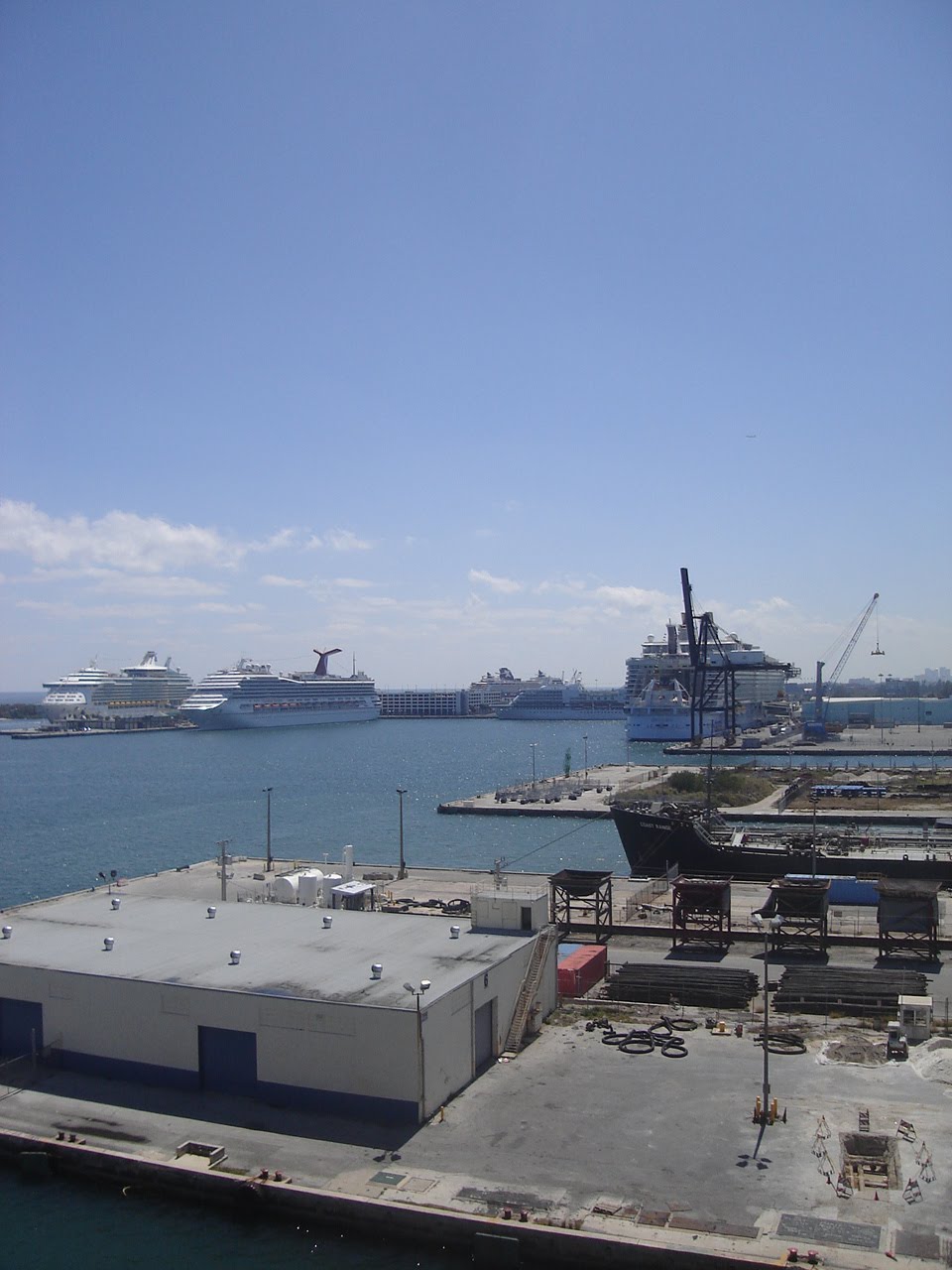
Fort Lauderdale - possibly the largest gathering of cruise ships in the world

We like to do business with the Americans because we can sue the crap out of them when they do something wrong. Thus, our only US port in months is one of myriads of service techs, sales people or wannabe’s. We get donuts, pens and baseball caps. Free advice on all kinds of things. Tune ups, shake downs and clever one-liners that were practiced in a mirror. And we get stores that make us think it’s Christmas. Pallet after pallet, truck after truck. Food, parts, fuel. The works.


And of course, the US border patrol would like to know if we’re all carrying our I-95’s. They march on board, all gunned up with nothing to shoot at. Ludin, apparently, comes from a solid pedigree of potential terrorists and is marched off for in-depth scrutiny. The remaining crew get subjected to the piercing inquiries of officer Snodgrass, a chubby good ol’ boy with a drawl that testifies of a heart for beef jerky and old John Wayne movies.
“Hey,” I say, “Are you related to the famous Snodgrass?”
Snodgrass speaks not but his eyes say, “Famous Snodgrass?”
“The poet,” I say helpfully, smiling fatherly, “Anne Sexton’s buddy…”
Snodgrass speaks not but his eyes say, “You want fries with that?”


A painful yelp rises from the belly of our beast. The store keeper’s trying to mush months worth of goodies into a freezer the size of a beer crate. And a timid ribbon of eerie reeking smoke just ascended from the main refrigeration plant. “Is that supposed to happen?” he asks sincerely curious.
“That depends on your religion,” I reply. “I like to believe that God causes all things to work together for good to those who love Him. Do you love God, son?”
“Is God going to repair my fridge?”
“Well,” I say, trying to stay on the theological straight and narrow, “God is an engineer, and I was made in His image.”
“I’ll make an extra strong pot of coffee then,” he says.
“You do that,” I say while pull a screw driver from my back pocket, release the stainless steel front and brace for an all-nighter. I can already feel the goodness of all things working together.

Fort Lauderdale seen from Port Everglades
A Princess monster docked in Port Everglades, Fort Lauderdale
Cruise ships docked in Port Everglades, Fort Lauderdale
The charming harbor mouth of Port Everglades

Saturday, January 8, 2011

Free wireless internet at Schiphol airport and crossing the American border

Something new at Schiphol: two wireless internet sessions of 30 minutes each absolutely for free, noppes, zip, nada! After that you get charged a hefty fee, I’m sure.

It’s six in the morning. I got up at 01:30, having slept about an hour. The highways were empty, so was the immense corridor that leads from the parking garage to the departure hall. Gate E19, however, where the flight to Detroit originates, is full of fellow travelers; all wearing expressions of dismay and self loathing. Next to us the walking conveyer urges to ‘mind your step,’ whenever a walker boards, which is every second and a half.

Abandoned Schiphol Airport

I’ve seen dozens of airports but Schiphol beats them all. The signs are clear, the people friendly, and the whole place is dressed in that charming introvert exuberance the Dutch are known for. Christmas trees are arranged in rigid patterns, commercial signs are controlled and matter-of-fact. No shouting, no chaos. Just order on order, a line here a line there.

Soon I’ll be on the other side of the Atlantic, in the country I’ve felt at home in for so long. There’ll be bright colors and loud noises. There’ll be a squadron of heavily armed Chuck Norris aficionados awaiting us. They’ll have bullhorns and cattle prods, and drive us towards customs booths, where we must leave our finger prints and pictures. A sign with pledges of friendliness and curtsey will have slid behind the counter.

Am I here for business or pleasure, officer Burley demands to know after I’ve stood in the non-residents line for two hours.
“Little bit of both. I’m boarding a ship.”
“Where’d you come from?”
“Home,” I foolishly submit.
“Home is America,” officer Burley replies sternly. How could I have been so ill informed?
“I come from the Netherlands,” I say.
“Are you a terrorist?”
“No sir!”

He lets me in, this time, and there it is: land of the free, home of the brave. I’m still in love with this country. She’s like an ex-girlfriend who broke us up when her options lured, who’s changed the locks and warned the neighbors, but now lives on in paranoid seclusion frantically clutching the belief that she’s been wronged.

God bless America; their home sweet home.

Monday, January 3, 2011

Wonderful tourism facts accidentally acquired from US government sites.

US government websites are among the slowest on the internet, and with all that government funding, this must have a reason. It’s my contention that they’re deliberately slow so that you’re forced to learn all kinds of wonderful things you never thought of inquiring about. Here’s what I learned from simply wanting to know how many tourists come to each separate State every year:

Manhattan is the most popular tourist destination in the US and draws roughly sixty times as many tourists every year as there are people living in Alaska. Hence Alaska is America’s less densely populated state, and Times Square is America’s most crowded couple of streets.

For every person living in Hawaii, there are ten tourists visiting there.

About eight times as many people visit Cape Cod every year than there are people living in Boston. And about forty times as many swing by Faneuil Hall.

A little less than half of the tourists in the US come from Western Europe. A little over a quarter come from Asia. That means that roughly 25% of visiting foreigners in the US come from countries that most Americans have never heard of.

For every business trip to the US there are two holidays, and tourists tend to stay more than twice as long as business people. Another curious detail is that in the US there are slightly more overseas tourists traveling alone than overseas business folk traveling with associates. Also worth mentioning is that for every 16 visitors that say they’re there for leisure, one is sneakily there for business, while for every 22 so-called business visitors there’s one who does nothing but hang around and get a tan!

Among tourists to the US there are about twice as many first-timers as there are among business people, which leads to believe that it’s better to keep doing business with Americans than to keep visiting them socially.

Tourists to the US are slightly more often male than female, but if they come to do business they’re much more often male. This may mean that there are more men in overseas businesses but it may also mean that overseas businesses prefer to keep their women close to home.

Male visitors are in general four years older than women visitors, no matter if they come to do business or to go sight seeing. Tourists are in general one year older than business people, which makes perfect sense. Curiously enough, business people who come to the US have roughly a 15% higher annual income than tourists who come to the US.

How many tourists actually visit any specific State per year remains a mystery.

Tuesday, December 28, 2010

Driving in Boston, Netherlands, Poland and Belgrade


Branko Bridge at midnight - Belgrade, Serbia
 Looking at how people behave in their cars is an excellent way to estimate how people are when they’re not in their cars. I’ve driven all over the world but taking the car into any metropolis remains a daunting enterprise.

In Boston, for instance, driving means partaking in a collective panic attack. The flow of traffic is largely organic, meaning that drivers don’t typically stay in their lanes but go wherever the traffic pushes them to go. Honking the horn is ultimately ineffective in congested traffic but Bostonians lean in on that thing like there’s no tomorrow. Leaning out the window and diverting blame is also an integral part of Bostonian automotion. Meet a Bostonian out of his car and he’ll seem to apogee of chivalry. But beneath that composed exterior shudders the heart of a chicken.

In the Netherlands people drive with calculated precision. They also drive 120 kilometer per hour, stay at a safe distance from the next guy and rarely honk their horns. Once there was a fire in a tunnel. Folks that drove into the tunnel brought their cars slowly to a standstill, waited until the cars behind them were stopped too, put the car in reverse and slowly backed the whole herd out of the tunnel. No one was hurt. No car was damaged.

Driving in Poland is like driving in Boston during a Martian invasion. It’s not unusual to see five cars side by side going in three directions on a two-lane road full of holes. Poles will honk at each other for stopping, accelerating, overtaking or refraining from doing those things. Poles loath foreigners, loath Poles and loath themselves, and make that known by turning driving into a perpetual assassination-slash-suicide attempt. Speed limits mean nothing in Poland. Stripes on the road mean even less. Fans of demolition derbies should all move to Poland and let it rip.

Much to my surprise, driving in Belgrade is much more like driving in the Netherlands than driving in Poland. Even though Belgrade is fantastically congested, Belgradians are courteous, cautious and precise. They’ll let you in, give you right of way and only honk at you when you really deserve it. Drivers in Belgrade all seem to share the knowledge that cars are expensive and lives are easily destroyed. As in any big city, drivers in Belgrade will suffer an occasional ‘Flojd moment,’ but in general the going is slow and easy.

I have a theory about that.

When the iron curtain fell, only very few people in Poland owned a car. In the early nineties especially young people went abroad to earn money, and when they came back (if they came back) they would buy cars. That means that the collective driving tradition in Poland is very young and upheld largely by impetuous and discontented kids.

In Serbia, owning a car was very common during the Tito years. When the economy collapsed, salaries decimated but the cars that people had stayed those same cars. Somebody with a car that once set him back an annual salary suddenly owned a car that was worth ten years of labor. When the gas prices went up, people drove less and very careful when they did.

Nowadays salaries in Serbia are about 10% of what they are in the West, but the traffic seems quite equal to that of the West. There are very few shitty-olds and many well-maintained small sedans. Occasionally the stray Mercedes or BMW will zip by, but cars in Belgrade are mostly 10 year old hand downs from Germany and Italy. And they’re driven with the same grace and hospitality the Serbs will show when they’re not driving.
Related Posts Plugin for WordPress, Blogger...