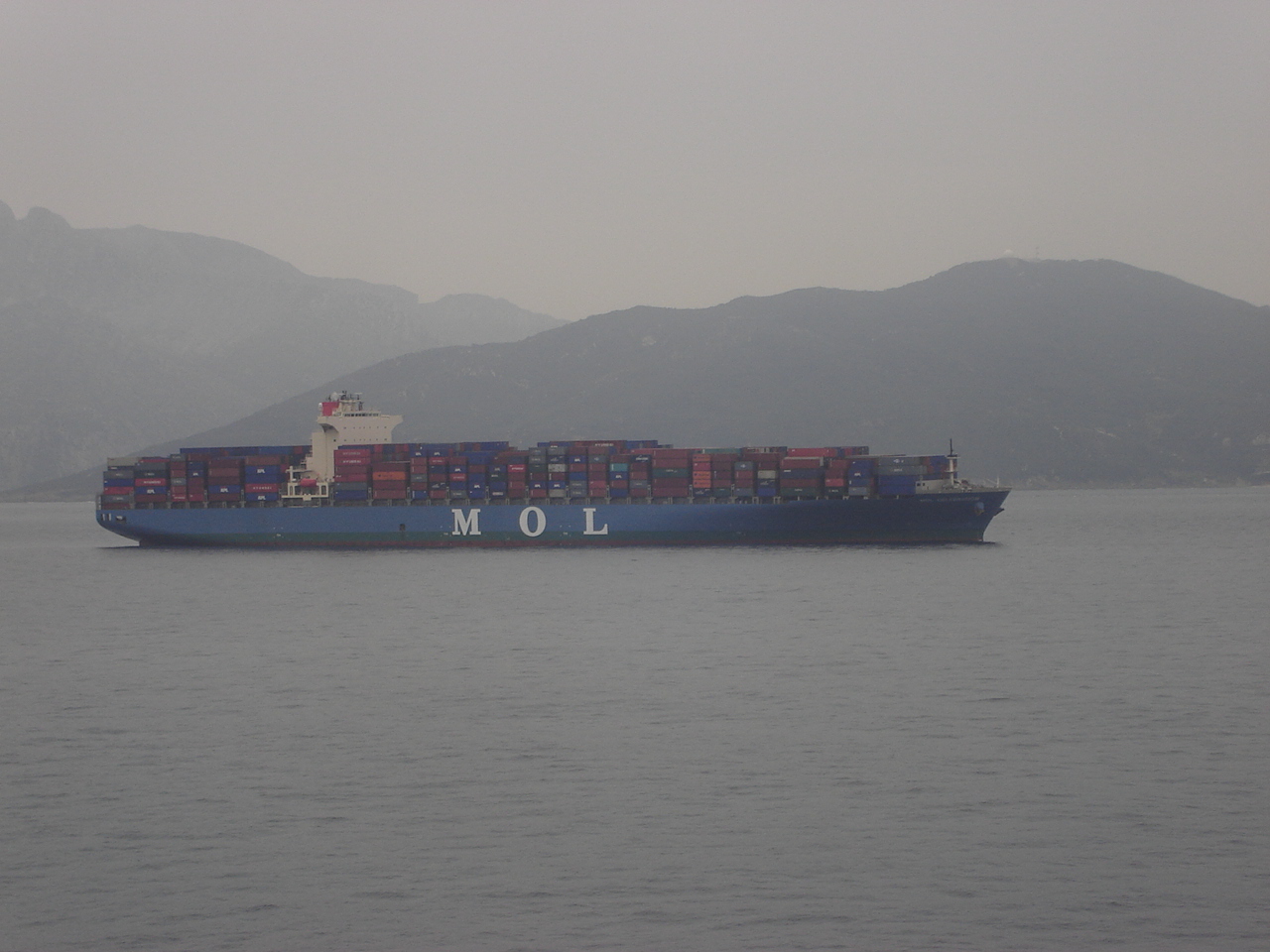
We’re gliding into town through what’s said to be the largest natural harbor in the world. Since Menorca is also a tiny island, I’m forced to conclude that half of it consists of harbor. But what a sight for sore eyes; I feel home at once. Tiny European houses built smack on the shore, which is doable because there are no tides here. The Med feels like a big lake to sailors; no tides, no swell to speak of. But if Al Gore is right and the water level will rise by two meters, we’re in for a dip here in Europe. Unless of course they build some kind of dam across the Gibraltar Straight, with locks like they have in the Panama Canal. And do the same with the Suez Canal. They would have to install a bunch of pumps too, I guess, because then the Med won’t drain naturally into the Atlantic. It’ll take some thinking but hey, they can always come and learn from the Dutch because the Netherlands has been below sea level for centuries. We had the Southern Sea that’s now the IjselLake. Who said it couldn’t be done?
And while we wait to see if Al Gore is right, we can enjoy cute ports such as that of Mahon, the capital of Menorca, which is an island in the Balearic group that also contains Ibiza and Mallorca. These islands have been inhabited since the Neolithic era. There are remnants aplenty; boulders turned upright defying time and leaving the onlookers guessing at the why of them. Then there are traces of the Romans and pretty much every invading force since. We pass buildings on little islets that are unmistakably Napoleonic, but quickly the coast is dappled with splendid waterfront villas, all with private beaches and docks and boat houses. Downtown, where we end up, a boulevard filled with restaurants and bars curves along the water’s edge. Yachts of all sizes are tied up in rows, and there’s even a blue fisher boat from Barendrecht, a Dutch city close to where I was born.
Menorca’s claim to fame is the invention of salsa mahonesa, known in the rest of the world as mayonnaise.
A bastion from the Napoleonic era in the harbor of Mahon, Menorca
The Barendrecht, making Mahon, Menorca look like a toy town.
We arrive when it’s still dark but as soon as the sun is up and I tear away from the goings on, the town of Cartagena fills me with memories of grandiose plans and romance. Row after row of yachts of all sizes bob in the marina. Buildings from every age thrust up from the sandy soil, and there is a handsome promenade to separate the two.
“What I want,” I tell Draga, who is always interested to hear what I want, “is to drive the entire southern coast line of Europe, in a camper.”
“We’re buying a camper now, hm?” she says with a tone of gentle forgiveness in her voice. “Is that before or after you build our house in Belgrade, with a library for you to work in and with a tower that overlooks the Danube? Coffee and donuts on the balcony? To the theater twice a week?”
“You’re forgetting the indoor swimming pool and the sauna,” I say. I have the tendency to loose grip on monetary reality after three months of hard work, 12 hours per day with barely any recreation. I also want a live-in kitchen and a yard to run around in.
Then we stare out over the town, imagining having the time to even see each other for longer than a coffee break once or twice a day. We’re both exhausted. We’re losing weight like drunk dromedaries. “I just want to be with you in a tiny little space and hold you,” she says while my eyes follow the road that meanders along the coast and up the hills, past an ancient looking building and across the horizon. A camper it is then, I hear myself say. Draga holds me closer for a brief moment. Then she has to go.
It’s always a milestone in any journey: crossing Gibraltar Straight. We look forward to it for weeks and then it’s over in an hour or two. But thank God we’re off the Atlantic. From a sailor’s point of view, the Mediterranean really is a big lake; there are hardly any tides and hardly any swell. Sailing the Mediterranean is a walk in the park, so to speak.
The weather is always a surprise in Gibraltar Straight (as it is anywhere else, I suppose). Sometimes gales get bottlenecked to full fledged storms and passing the straight is like passing a cactus. Sometimes it’s spectacularly clear and you can count the leaves on the trees on either side. Once I’ve seen a wind-still day produce strange whipped-cream globs of clouds just sitting on the water, for us to circumvent.
Today conditions are boring but not very trying. Rain and fog keeps the Rock of Gibraltar from our sight. We pass along the African Coast, along with countless other ships, safely separated in a convoy going west and one going east. And as we stand and stare and each other, we notice the dorsal fins and arched backs of a large herd of dolphins moving gracefully between us out the Mediterranean and onto the Atlantic.
Something new at Schiphol: two wireless internet sessions of 30 minutes each absolutely for free, noppes, zip, nada! After that you get charged a hefty fee, I’m sure.
It’s six in the morning. I got up at 01:30, having slept about an hour. The highways were empty, so was the immense corridor that leads from the parking garage to the departure hall. Gate E19, however, where the flight to Detroit originates, is full of fellow travelers; all wearing expressions of dismay and self loathing. Next to us the walking conveyer urges to ‘mind your step,’ whenever a walker boards, which is every second and a half.
Abandoned Schiphol Airport
I’ve seen dozens of airports but Schiphol beats them all. The signs are clear, the people friendly, and the whole place is dressed in that charming introvert exuberance the Dutch are known for. Christmas trees are arranged in rigid patterns, commercial signs are controlled and matter-of-fact. No shouting, no chaos. Just order on order, a line here a line there.
Soon I’ll be on the other side of the Atlantic, in the country I’ve felt at home in for so long. There’ll be bright colors and loud noises. There’ll be a squadron of heavily armed Chuck Norris aficionados awaiting us. They’ll have bullhorns and cattle prods, and drive us towards customs booths, where we must leave our finger prints and pictures. A sign with pledges of friendliness and curtsey will have slid behind the counter.
Am I here for business or pleasure, officer Burley demands to know after I’ve stood in the non-residents line for two hours.
“Little bit of both. I’m boarding a ship.”
“Where’d you come from?”
“Home,” I foolishly submit.
“Home is America,” officer Burley replies sternly. How could I have been so ill informed?
“I come from the Netherlands,” I say.
“Are you a terrorist?”
“No sir!”
He lets me in, this time, and there it is: land of the free, home of the brave. I’m still in love with this country. She’s like an ex-girlfriend who broke us up when her options lured, who’s changed the locks and warned the neighbors, but now lives on in paranoid seclusion frantically clutching the belief that she’s been wronged.
Republic Square sits in the heart of Belgrade, and many say it is the heart of Belgrade. It features the famous statue of Prince Michael and is bordered by the National Theatre and the National Museum. In 1997 it was the site of the anti-Milosevic rallies.
A visit to the National Museum has been on my wish list ever since I arrived in Belgrade, and Draga kindly planned it into to our busy schedule. “It’s enormous,” she says excitedly, as I cast one more look upon the sizable scrotum of Prince Michael’s horse. “I visited this museum at least ten times in my youth. If you want to understand my people, you should see this museum.”
Caryatides by Ivan Mestrovic
at the National Museum of Serbia
The entrance on the square is blocked by scaffolds but the one on Ulica Vase Carapica is open. We enter and ascend a wide staircase flanked by two imposing rows of Caryatides, created by Ivan Mestrovic, who also made Victor, the signature statue at Kalemegdan and symbol of Belgrade.
A tired man with glasses like jam jar bottoms and wild curly hair sits in the ticket booth. The photo on his ID proves that he was young once. He smiles wryly as Draga orders two tickets, and informs us that the National Museum is closed for tourists and has been closed for a decade, ever since the NATO bombing of 1999. The collection is in storage in the basement. “For students of history of art we keep a special program, with the highlights on display. Not many of those come here though,” says the man.
There are plans to reinstate the museum but the board needs 100 million Euro to accomplish that, the man insists. Somehow that seems a bit excessive to me, but I recognize the grim reality of a culture that does have money to build enormous shopping malls and a cathedral devoted to the national hero Saint Sava, but not to preserve the memories of a troubled past.
“A wounded man will try to become better first,” explains the man, “Only when he’s back on his feet, he might want to know what struck him down.”
He’s been here his whole adult life and has seen it all; the masses mourning after Tito’s death, Milosevic working the crowds when they still believed him, and their protests when they did no more. He held on to his ticket counter when the bombs destroyed the buildings around him and when the people outside began to celebrate peace. He sat there when men crated the relics that told it all and carried them down to the basement.
We say goodbye to the man, and sink to street level between the parades of Caryatides. They stand there as proud as they were when they were first installed and care not that they uphold an empty vault, or even supply the last refuge of a man who hold a nation’s history behind his tear filled eyes.
The English speaking traveler to Serbia will be pleasantly surprised to find pretty much everybody capable of conversing in English on a basic level. And the same traveler will be even more surprised to find many young Serbs fully fluent in English.
The national language of Serbia is Serbian, which is a Slavic language based on a Latin grammatical structure. That means the daily conversation covers three genders, eight tenses and seven declinations, which any foreigner will find virtually impossible to master. Wisdoms conveyed in Serbian supersede Boolean logic, as demonstrated by the double negation feature, which never ceases to flummox me. The perfectly proper sentence “Nista nemam” literally means “Nothing I not have,” which logically means “I have everything,” but which every Serb understands to denote a complete absence of possession.
Seen at Tesla Airport
Belgrade, Serbia
Slavic and Germanic languages (such as English) are so different that even the most seasoned late learner will never get the hang of either one. The afore mentioned declinations are the terror of the student who comes from a language area that does not deflect nouns. On the other hand, elements of the English language that we find utterly simple - such as the use of the (in)definite article - will remain a mystery to Slavic native speakers.
I’ve heard Serbian people say things like “all the night long,” or “wash car with the soap,” and then proceed to use words like “undulation,” “torpid” and “ostentatious.” I don’t know enough about the Serbian language to make a valid assessment but I’m guessing that the general Serb commands an incredible vocabulary and library of metaphoric images.
I was at an Internet café, nervously pacing between computer and printer, when the girl behind the counter said, “Don’t worry; I’ll fetch them for you.” Another time I met a fellow on a street corner holding a hand on his head, looking troubled, and I asked him what was up. He pointed at a piece of billboard that had come flying from a stand and said, “That struck me.”
A native from the Unites States would have said, “I‘ll get‘em for you,” and “I got hit.” A Brit would have invoked body parts at both occasions. An Aussie would probably have said something not relevant to either situation, and incomprehensible to anyone not an Aussie.
In the short period I’ve been here, I’ve only read a few books that were translated into English from Serbian. What I’ve noticed is that the Serbians like their texts as Baroque as Mozart, their style verbose and meandering as if every article is a play. It almost seems that the subordinate clause is the primary means of verbal expression in Serbia.
“People who grew up on a stone hill beneath such an exciting panorama cannot but be broad of gesture, stormy of temperament and changing of mood. These people, who stay in their city despite everything, even as history destroys and crumbles it, covering the land with layers of leaves and remnants of previous settlements and past civilizations, such people are capable of building their city anew, in a relaxed and unpretentious way; they are capable of building a city of human proportions.”
- Momo Kapor; A Guide to the Serbian Mentality.
Book sellers in Belgrade, Serbia
The Serbs are not only polyglots, capable of astounding precision in various languages, or so hooked on books that there are more bookseller than hot dog vendors on the streets of Belgrade, they also maintain two alphabets: the Latin one that I now use to talk to you albeit expanded with all kinds of dots and jingles to form 30 separate letters, and Cyrillic. Cyrillic was the original alphabet of the Serbian culture (standardized in 1814), and it’s still ubiquitous in Belgrade. It’s almost as if the heartwarming hospitality of the Serbs comes with a friendly warning that the heart of Serbia is quite private and guarded with a public key. I like that.
Plato Book Store
(Menu of the coffee corner)
In order to play a part on the global marketplace, the Latin alphabet was adopted by Serbia in 1830 (the same happened in many other countries, such as China and Japan). But because the original Cyrillic is far richer in sounds than, say, written English, the Latin alphabet had to be augmented with diacritics. This richness is consonants is so strong even that the Serbian language has words that are written without vowels. Utterly curious to a foreign observer are words like krnj (meaning defective) or krst (means cross).
Bil Brajson (Bill Bryson)
Made in America
Another curiosity is that some words that are incorporated from other language would be pronounced incorrectly when absorbed as-is. That leads to formations such as Academija (Academy) and kvota (quota). Even names befall this fate. In Serbia, Angelina Jolie is known as Andjelina Djoli, I am Ari Ajtenbogard, and I was amused and endeared to find books by my beloved author Bill Bryson offered under the name Bil Brajson.
The title of his book Made In America remained unchanged, and no Serb in the bookstore seemed to mind.
To be, or not to be– that is the question: Whether 'tis nobler in the mind to suffer the slings and arrows of outrageous fortune, or to take arms against a sea of troubles and, by opposing, end them.
-Shakespeare, Hamlet
The Horse Statue at Republic Square in Belgrade, Serbia
Quite literally at the heart of Belgrade stands the statue simply known as The Horse. It’s located on the central Trg Republike (Republic Square), but it’s also the prime reference point of the city. Before venturing into town, clubbers meet ‘at the horse,’ and every direction to any other sight-to-see starts with the horse. To get to Kalemegdan, walk from the horse to Knez Mihailova, and follow that street in the direction of the horse’s but. To get to theatre Atalje 212, follow the arm of the guy sitting on the horse.
But who is the guy sitting on the horse and where is he pointing at, other than theatre Atalje 212?
Horse Statue - Belgrade, Serbia
Equestrian statues are common in our world. They usually depict military leaders who played crucial roles in the evolution of countries. Rearing horse statues are rare because balancing such a sculpture necessitates the horse to be almost vertical, and that will inadvertently push the rider into a pose that fails to convey an authoritative and astute composure. Subjects like to see their rulers to be in control of things. A horse that caries such a ruler has no business rearing. It should slowly but surely progress.
Hence, horses are commonly shown to daftly step, in subject to their rider, who usually sits there pointing at something. His pointing shows the ruler’s determinative aim for some kind of objective, which is a future state much rather than a physical destination. The horseman of Belgrade does so too. But he did that at some point in the 19th century, when his nation still had a very long trot coming.
Prince Michael - Horse Statue
Prince Michael (Mihailo Obrenovic) ruled Serbia as a vassal subjected to the Ottoman Sultan. He strengthened the nation by supporting Serbian literature, and in the early 1880’s he reorganized the Serbian army into becoming the strongest army in the Balkan. To give his creation a try he revolted against the Turks, who withdrew into Kalemegdan and started bombing the town from within. Prince Michael felt forced to call off his armed revolt but continued his resistance on the diplomatic front. In 1867 the Turks pulled out of Belgrade, and some years later they surrendered all control of Serbia. That ended their 400 years occupation.
It also ended the brutalities with which the Turks would keep the Serbs subdued. One way of executing insurrectionaries was impaling them in front of the Stambol Gate. When the Turks left, that gate was razed to the ground, leaving an open space in the city that would become Trg Republike. (An ‘inner’ Stambol gate can still be found at Kalemegdan). In 1882 the square was adorned with a monument to Prince Michael seated on a stallion. Perhaps he points at a liberated Serbia, perhaps he’s showing the Turks or any other invasion force the door, and perhaps he’s pointing merely to show that the going is compulsory; countries must evolve just like rivers must flow.
Horse Statue on Republic Square - Belgrade, Serbia
Belgrade was bombed in 1914 by the Austro-Hungarians, by the Luftwaffe in 1941, by the Allies in 1944 and by the NATO in 1999.
Prince Michael never experienced the independence of Serbia. He was assassinated in 1868. But on Republic Square, Prince Michael will never stop pointing, and the Belgradians will never stop meeting.
Looking at how people behave in their cars is an excellent way to estimate how people are when they’re not in their cars. I’ve driven all over the world but taking the car into any metropolis remains a daunting enterprise.
In Boston, for instance, driving means partaking in a collective panic attack. The flow of traffic is largely organic, meaning that drivers don’t typically stay in their lanes but go wherever the traffic pushes them to go. Honking the horn is ultimately ineffective in congested traffic but Bostonians lean in on that thing like there’s no tomorrow. Leaning out the window and diverting blame is also an integral part of Bostonian automotion. Meet a Bostonian out of his car and he’ll seem to apogee of chivalry. But beneath that composed exterior shudders the heart of a chicken.
In the Netherlands people drive with calculated precision. They also drive 120 kilometer per hour, stay at a safe distance from the next guy and rarely honk their horns. Once there was a fire in a tunnel. Folks that drove into the tunnel brought their cars slowly to a standstill, waited until the cars behind them were stopped too, put the car in reverse and slowly backed the whole herd out of the tunnel. No one was hurt. No car was damaged.
Driving in Poland is like driving in Boston during a Martian invasion. It’s not unusual to see five cars side by side going in three directions on a two-lane road full of holes. Poles will honk at each other for stopping, accelerating, overtaking or refraining from doing those things. Poles loath foreigners, loath Poles and loath themselves, and make that known by turning driving into a perpetual assassination-slash-suicide attempt. Speed limits mean nothing in Poland. Stripes on the road mean even less. Fans of demolition derbies should all move to Poland and let it rip.
Much to my surprise, driving in Belgrade is much more like driving in the Netherlands than driving in Poland. Even though Belgrade is fantastically congested, Belgradians are courteous, cautious and precise. They’ll let you in, give you right of way and only honk at you when you really deserve it. Drivers in Belgrade all seem to share the knowledge that cars are expensive and lives are easily destroyed. As in any big city, drivers in Belgrade will suffer an occasional ‘Flojd moment,’ but in general the going is slow and easy.
I have a theory about that.
When the iron curtain fell, only very few people in Poland owned a car. In the early nineties especially young people went abroad to earn money, and when they came back (if they came back) they would buy cars. That means that the collective driving tradition in Poland is very young and upheld largely by impetuous and discontented kids.
In Serbia, owning a car was very common during the Tito years. When the economy collapsed, salaries decimated but the cars that people had stayed those same cars. Somebody with a car that once set him back an annual salary suddenly owned a car that was worth ten years of labor. When the gas prices went up, people drove less and very careful when they did.
Nowadays salaries in Serbia are about 10% of what they are in the West, but the traffic seems quite equal to that of the West. There are very few shitty-olds and many well-maintained small sedans. Occasionally the stray Mercedes or BMW will zip by, but cars in Belgrade are mostly 10 year old hand downs from Germany and Italy. And they’re driven with the same grace and hospitality the Serbs will show when they’re not driving.
The quaint Ruzica Church, hugging the wall of Kalemegan fortress, should be high on the wish-list of every visitor to Belgrade, Serbia. In the summer it’s entirely covered in green ivy, making it one of the most appreciated churches in the world and a symbol of Belgrade’s recuperation.
Ruzica means Little Rose, or Rosie (the diminutive of Ruza), although its official name is Church of the Nativity of the Most Holy Mother of God. Belgradians started calling it Ruzica when a local legend began to take root.
The story goes that once, some six centuries ago, there were two ruling brothers Jaksici, who together had three daughters: Dragica (after draga meaning precious; darling), Ljubica (after ljubav, meaning to love; beloved) and Ruzica; little rose. The brothers built three churches; one for each daughter. The churches were originally named after saints but the people of Belgrade rendered them the names of the three Jaksici daughters.
Ruzica Church Interior - Belgrade, Serbia
Wars destroyed the churches of Dragica and Ljubica, and only the church of Ruzica remained, even when the Turks invaded and occupied Serbia. When the Austrians conquered Belgrade, they made Rose Church into a gun powder store. The Turks retaliated, drove out the Austrians but recognized the merits of Rose Church as an arsenal.
Late nineteenth century the Turks were kindly asked to leave Belgrade to the Belgradians, and after some inventive incentives they actually went. Rose Church was cleared from ammo and reinstated as a church.
Chandelier Ruzica Church - Belgrade, Serbia
Since Rose Church is located at Kalemedgan, an ancient battle fortress, remnants of war abounded. To commemorate the persistence of the Serbs and their Rose Church, some of the spent bullets, swords and other weaponry that were unearthed during clean up were collected and made into striking chandeliers.
That the church is now entirely covered in green vegetation is unanimously recognized to be a sign from God: Rose lives and will forever.
Visitors to the battle fortress of Kalemegdan in Belgrade will see a gold cross over the north wall. By all means, follow that cross, because below it sits one of the prettiest little chapels you’ll ever see: the church of Saint Petka.
Church of Saint Petka - Kalemegdan, Belgrade
Petka, or Parascheva (Greek for Friday; kind of cute in a Robinson Crusoe kind of way) was born in the 11th century, in Epibatos, a town in Turkey, just west of Constantinople. Like Saint Martin, she too gave her clothes away to beggars. She lived as an ascetic in Jerusalem for a few years but then went home. She died anonymously at age 27 and was interred in an unmarked grave.
Some years later a dead sailor washed ashore and he was buried next to Petka. But his corpse gave off such a pungent smell that saint Petka felt compelled to appear to a local monk, with the request to move her body away from the stinking sailor. When the villagers dug up the body of Petka, it was found to be in tact, and she was recognized as a saint. The body was transferred to a more worthy place.
The Woman at the Well
Church of Saint Petka - Kalemegdan, Belgrade, Serbia
“But we have her finger,” says Ilija Jovicic, the friendly young priest. Taking pictures in the chapel is forbidden but I get special permission. He even shows us around.
“Try some of the water,” he says, pointing at the famous spring water that comes trickling down a pipe, into specially manufactured Petka bottles.
Although there have been chapels on this spot for centuries, the present church of Saint Petka was built in 1937. The stunning mosaics are from the early eighties.
Should you ever be in Belgrade with an evening to spare, do yourself a favor and go to any play that features Dragan Jovanovic. I’ve seen two now and although I understand about five Serbian words, I spent both evenings in stitches.
Dragan Jovanovic is Belgrade’s resident jester as much as political mirror. His plays invariably take the piss out of everybody and anything but always in the kind manner of a family friend. He never insults but eagerly shows how silly we really are.
Jovanovic & Company
More Boney M than Boney M
His vocal range is enormous; he’ll squeal out in arrested amazement, howl like a banshee or cheer on an invisible football team in hoarse brays. Whenever there’s a need to, he dances like only he can.
No one is immune to his antics. Even his fellow actors jackknife on occasion, and the play is suspended, the fourth wall is shattered and Dragan Jovanovic prances about wallowing in standing ovations.
Jovanovic as Che (or Gay?) Guevara
If you haven’t seen Dragan, you haven’t been to Belgrade.
The castle’s been luring us since we arrived. We can see it from our window, through the concrete high rises; a park with lawns that are green even in the winter, surrounded by an ancient wall. On its highest point is the castle itself: Kalemedgan.
We walk side by side as if we’re representing a new Europe that looks back on its past; she is Serbian, I am Dutch. She’s orthodox, I am protestant. While I grew up in economical prosperity, she stood in line for bread. Now my world is overflowing hers. We follow the pedestrian shopping street Knez Mihajlova until we reach the entrance to the park. I’m pleased to see welcoming signs with clear explanations of what this building is all about.
For millennia people have drawn towards the confluence of the rivers Sava and Danube, and where these signature rivers kept washing the land clean, armies brought their conflicts and left their dead and weaponry, planted flags and claimed this magical spot for themselves.
Inner Stambol Gate - Kalemedgdan, Belgrade
The confluence has been occupied by settlers since antiquity. In the third century BC, Celts proclaimed it a dwelling but were disposed by the Romans. By then there was already a fortress there. The Romans battled the Huns from it, and legend has it that Attila’s body was interred below its walls.
The Turks conquered the fortress in the 16th century and called it Kalemegdan, after the words for battlefield and fortress. At the conclusion of the four hundred years Turkish occupation (with intermitted visits from the Austrians), the city of Belgrade decided it needed a monument to commemorate Serbia’s brittle victories. The world famous Croatian sculptor Ivan Mestrovic was commissioned to create it. He finished the statue to see its installation thwarted by the outbreak of the First World War. The conflict left much of Belgrade destroyed but not the statue.
Victor - Kalemegdan, Belgrade
“His name is Winner,” says Draga, pointing at the huge, naked man on his pedestal. “He’s the symbol of Belgrade,” and explains that the Serbian word podobnik comes from the verb pobeda, meaning to win. In English this statue is known as Victor.
In 1918, the federation that would later be called Yugoslavia was pronounced in the Corfu Declaration, and the statue called Victor was erected on the edge of Kalemegdan’s grounds. It stood there silently overlooking the city in 1941 when Belgrade was bombed by the Luftwaffe, in 1944 when it was bombed by the Allies, and in 1989 when it was bombed by the NATO.
Victor - Kalemegdan, Belgrade
We stand looking up at the impressive sculpture. Victor offers the dove of peace on his outstretched left hand, but holds a sword in his right, hugged to his chest. The expression on his face is both defiant and entreating. Through his partly parted lips he seems to both expel a sigh of hope and a muffled provocation. His eyes, however, are decidedly passive, concerned even. Victor has the body of a war god but the face of an observant child.
My search for the heart of Serbia leads me to a studio in Belgrade, where I am to meet with one of Belgrade’s most promising young musicians; Novak Askovic, just 23 years old, who’s already managed to leave a mark on the local music scene, and is now putting Belgrade on the musical map of the world. But this world-mapping is going far too slow, according to some observers. What’s keeping Novak?
For a few moments I stand in front of a unmarked door. Then it opens.
“Come in,” says the handsome young composer generously, “I was just working on a score for a movie.”
I had secretly expected to find empty booze bottles strewn about and the familiar scent of weed hanging like a mist over the mixing tables, but no, there aren’t even ash trays. Novak doesn’t do drugs, doesn’t drink, doesn’t even smoke.
“I do music,” he says shortly.
“What’s this called?” I ask as suspense, thrill, careful confidence and sensual tension slowly build up. Synthesized strings sway over a clean snare and a deep, almost ska-base. The frivolous melody is carried by a plucky piano riff.
“It’s the score for a movie that doesn’t have a title yet, so my score doesn’t have a title yet either,” says Novak concentrating on his screen, searching from folder to folder through his master pieces.
“Scoring movies, is that your main occupation?
“For now I pay the bills with creating scores for movies and theatre productions. Soon we’ll be able to live off pure inspiration. A movie score augments visual images, but music in its purest form must be vivid enough to evoke images on its own.”
I’m mostly into classical music but even though Novak’s creations are a little out of my league, I do recognize quality when I hear it.
“I love classical music too,” says Novak, now leaning back into his chair, holding his hands behind his head, “But classical music is old. It’s been done before. I make new stuff, just like the classical composers who you like did. People like Mozart, Bach and Shubert didn’t get big from doing what everybody else was doing.”
In a split second I inspect his experimental studio. The only synthesizer in the room is a old Yamaha that looks like it has seen the rise of House in the eighties. Over a slot it says, “Insert floppy here.” A yellow post-it note says “London called.” Who’s London, I wonder.
“Do you ever make House?” I ask intelligently. Novak snickers. “It takes five minutes to make ten minutes of House,” he says, “Everything you need for House is a side-chain, sprinkle it with beeps and gimmicks and you got yourself a House hit. House is poverty. I’m Dubstep, drum-bass, all that. Everything is experimental.”
Novak Askovic
Musicians struggle with the issue of money everywhere, but musicians from a challenged economy, such as that of Serbia, must always have been at an unfair disadvantage. Instruments tend to cost an uneven fortune to folks who have no idea where their next meal might come from, and when they’ve finally saved up enough to buy an instrument, their economic disadvantage makes it difficult to seek out musicians from other cultures and study their work. Now that music in made mostly on computers, it doesn’t matter anymore how old the computer is (creating a piece on Windows 92 will sound the same as one made on Vista, it’ll just take a bit longer).
“We’re no longer bound to genre or even location, for that matter,“ says Novak cheerfully. “Through the Internet I can listen freely to music from all over the world, and adapt what I like and reject what I don’t.”
His phone rings. Novak mumbles short commands in English and disconnects.
“Vienna,” he says as if I’m supposed to know what that means.
“Can you explain the title Hormon (Serbian for Hormone)?” I ask as Novak changes the track. “Listen,” he says. “If I have to talk about my music, my music would be inadequate. I’d have to become a writer, like you.”
“There’s Prodigy here,” I note. Novak politely concurs but then explains that Bach is also not in every violin concerto, just because Bach wrote some.
Then I hear it. Where Prodigy sounds mostly intrusive, Novak stays harmonic. Prodigy expresses mostly discontent but Novak’s piece carries desire and passion. When the haunting vocals of Bojana Racic kick in, I’m sold and drift off into a lucid trance. I see caravans of camels towing Joseph off to oblivion; Cathy cry out for Heathcliff over the windy moors, and 47 Ronin weep in anguish over their dead Daimyo.
“My music tells stories,” explains Novak helpfully. “Each one of my pieces has what I call a movie-moment; a harmonic climax that will absorb the listener and trigger visual images. In Hormon I use a Shamisen, a Japanese instrument - you can even hear the clash of swords - but the harmonies are still western.”
Chakra unfolds into something distinctively Arabian. “Do you think that Serbia’s 400 years of occupation by the Turks makes it easier for you to adopt Arabian sounds into your music?”
“What? Which Turks?” he replies wildly. “No you’re wrong. I also don’t incorporate yodeling or the MacDonald’s theme song, unless of course I find them musically striking. I scrounge the global music scene for unusual sounds and musical oddities and incorporate them based on their musical merits.”
“How come you’re not all over YouTube?” I ask. I tried to do some preliminary research but all I found were two songs that were uploaded years ago. “I made those when I was eighteen,” says Novak. “I’ve evolved since then. Now I tell stories and people should take their time to listen to them. They’re worth it, I can promise you that. I don’t want to create entertainment for bored people. Slow is better. Quick release gives you a quick but short career. I want my music to make a permanent mark. To stay there for years and years. I gave Chakra to one person and now it’s all over Belgrade, clubs and radio stations.”
“But isn’t that the dream of every musician?”
“There’s no money in publishing music. Money comes from live performances. The dream is to have people look for your music because they saw you perform live. We’re waiting for the right moment. We’re producing an album for Serbia release, but we‘re waiting until everything is just right. Launching a project such as this must be carefully planned. So that’s what we’re doing.”
“Is the musical climate of Serbia receptive of your kind of music?”
Novak stares at the floor for a brief moment. I can see I hit a nerve. “The musical climate in Serbia is still maturing. We’re the only group in Serbia that performs this kind of music live. But we’ve done DJ performances in Croatia and all around Serbia, and live performances at festivals with LTJ Bukem and Roni Size, both phenomenal artists. Future performances are scheduled all over Europe. A record label from Belgrade named IndieRecords published a CD, named CCBit. Evidence contributed a number named Blato (Serbian for Dirt). But it’s real Dubstep,” he warns as he leans over and hits enter.
“Aren’t you afraid that your right moment might never come?”
“No-no,” laughs Novak. “The right moment is not something that comes falling from the sky. The right moment is something you create, just like a musical composition. I spend 60% of my day composing music and 40% communicating with publishers and festival boards. The right moment is when you’ve created a storm and then cut the ropes that tie you down.”
“Who was that guy?” I mumble as I step out of the studio into the windy city. Ahead a grey Belgrade dons colors in the dawn. Behind me rises the basso drone of yet another Novak Askovic creation. I promise myself that before I’ll process my notes I’ll figure out exactly how I got this interview. Until I do, and probably after, I’ll live on in the realization that I’ve been moved like a pawn by a multifarious genius half my age.
Evidence
Evidence:
Novak Askovic: composition, key boards, production, DJ
Srdjan Adamovic: production, DJ
Nenad Bradas: production , MC
Bojana Racic: vocals
The spirit of Serbia is in no small part carried by a wholesome elixir called Rakija; a brandy-like distillate, home-produced from fruits like grapes, apricots or plums. As with all cooking, the secret ingredients are rarely revealed, and should a consumer’s taste buds survive a swig, they may discern a flavor that varies from house to house.
The quality of a man’s Rakija reveals his degree of devotion and artistry, which then becomes an indication of traits such as leadership and lovemaking. Since Raklija counts as ultimate proof, no other evidences are required.
But no unwitted visitor should mistake Rakija for mere booze to be imbibed. The testimonies of many experts have convinced me that Rakija takes care of a broad range of business. It works wonders on rheumatism, frees the chest and lifts the sediments. Rakija has been known to settle disputes, appease in-laws and raise the most downcast of spirits. It heals bones, cures flatulence and is even recognized as a most benevolent ointment or rubbing oil.
All gloom and misfortune vanishes with a nip and Rakija has even found a place in the religious experience of Serbia, in an adaptation of the Levitical ordinance of libation. At the conclusion of a Serbian funeral, bread and Rakija are served. Some of the Rakija is poured on the ground and the mourners say, “Bog da mu dusu prosti,” meaning ‘God forgive his soul.’
When Serbs make their glasses meet, they take care to look each other in the eye, and cheer ziveli! Ziveli comes from the verb ziveti, meaning to live. In that regard the Serbian drinking cheer is not unlike the Hebrew l’chaim, also derived from the verb to live.
It takes us half an hour to find the car and about five to drive from Ljubljana to Belgrade. The highways in Slovenia and Croatia are in excellent shape but as soon as we cross the border into Serbia the blacktop begins to show signs of wear and demise. We cheer as we pass the Beograd sign but as we come to a slow halt in the congested traffic on Branko Bridge I’m beginning to doubt he wisdom of bringing a car into Belgrade.
Parking is a problem in every European city - since none of them was built with cars in mind - but parking in Belgrade is a complete nightmare. The inner city is divided into three zones; each zone has its limit on how long you can park. In the red zone one may park 60 minutes tops; in the yellow zone 120 minutes, and in the green zone 180 minutes. Zones are indicated by a red, yellow or green sign that features an all-telling image of a tow truck. Dues are to be paid at kiosks or, very hip, by sending your license plate number per SMS to number 9111 (for the red zone), 9112 (yellow) or 9113 (green).
These rules apply between 0700 and 2100 on weekdays and until 1400 on Saturdays. During those hours, officers armed with palmtops patrol the streets in search of freeloaders, who get towed without ado. Any Belgradian will tell you that once your car gets towed off, it’ll take half your vacation to get it back.
Most tricky is the interface between inner city and surroundings, where the green zone somewhat jaggedly flows over into the free zone. There are no chipper smiley-signs or something like that to indicate that you’re in the free zone, but you can recognize it from the outrageous amount of cars that are parked virtually everywhere; on sidewalks and lawns, often side by side and often blocking each other, showing a candid confidence of the Belgradians that everybody leaves for work around the same time. But even during the day, parking spots are hard to find. It seems that Belgradians park their cars somewhere and leave them there for ever.
Draga guides me from alley to alley, from friend’s house to friend’s house. The phone rings continuously from even more friends telling her that someone they know saw a free spot somewhere, at the other end of town. It takes us over two hours to arrive at the conclusion that it’s easier for a camel to pass through the eye of a needle than it is for a foreigner to find a parking place in Belgrade. Morose but grateful we slide into the gaping hole of a parking garage in the heart of town. A small uniformed man with a badge and a Maclite welcomes us and promises to guard our car with his life. That will set us back a mere 90 Eurocents per hour.
Outside I raise my arm to hail a cab. About a dozen of them respond by rolling away from the curb towards us. Before Draga and I get in, we experience a moment of spiritual awakening as we stare at the pockets of emptiness they leave behind.
Franciscan Church of the Annunciation - Ljubljana, Slovenia
The undisputed eye-catcher of Preseren Square in Ljubljana, Slovenia, is the lollipop pink Franciscan Church of the Annunciation. It was built halfway the 17th century, which makes it a good five decades older than the Church of Saint Nicholas. It’s not immediately clear how an order that venerates poverty could be served or even acknowledged in a Baroque basilica, but perhaps this paradox is assailed in the near absence of light in the church.
Interior of the big pink church in Ljubljana, Slovenia
Darkness seems to be the going theme of the Franciscan Church in Ljubljana. Amidst a gloomy expanse - shadowy smears on the ceiling instill a vague reassurance that it’s probably covered with very beautiful but quite invisible scenes - are stellar islands of light. Up ahead over the main altar shimmers a depiction of Mary’s annunciation by the lily-bearing Gabriel.
INRI in Ljubljana's Church of the Annunciation
But the first object one will notice when entering the church is the unusual INRI to the side and forward of the main altar. It’s unusual because the arms of Jesus are more vertical than horizontal, but more so because its opulent execution is again quite contrary to Franciscus’ leanings. Another noteworthy detail are the tools in the hands of the two chubby cherubim, a hammer and a thong, which may point at a connection to freemasonry.
Another hint towards freemasonry may be found in the emblem on the front door, which reads MARIA, but also reminds of the rule and compass.
The name Maria on the door of the Franciscan church in Ljubljana
resembles the rule and compass symbol of freemasonry